

Table of Contents
- Understanding Custom Art Printing Services
- File Preparation and Technical Requirements
- Choosing the Right Print Medium
- How to Order Custom Art Online: Step-by-Step
- Commissioning Art Online: Best Practices
- Custom Art Project Timeline and Fulfillment
- Pricing, Profit Margins, and Cost Management
- Quality Control and Print-on-Demand vs. Inventory Models
- Frequently Asked Questions
Last Updated: September 2, 2026
Understanding Custom Art Printing Services
Custom art printing transforms digital files into tangible reproductions for walls, commercial spaces, and design projects. Unlike pre-made prints, ordering custom art online gives you control over dimensions, materials, colors, and finishing details. At Splashworks, we've helped designers, retailers, and hospitality businesses navigate this process. The journey from concept to finished piece involves technical specifications, material choices, quality standards, and logistics that require upfront attention to avoid costly mistakes.
Digital printing technology now rivals traditional methods in quality and speed. Print-on-demand models eliminate inventory investment, while in-house production capabilities allow faster turnarounds and greater customization. Understanding which approach fits your project determines both costs and timeline.
File Preparation and Technical Requirements
Your digital file must meet specific technical standards before ordering custom art online. A beautiful image on screen can become blurry and color-shifted in print without proper preparation.
Resolution, Color Profiles, and DPI Standards
Resolution is measured in DPI (dots per inch). For custom art printing, you need a minimum of 300 DPI at your final print size (adobepress.com). An 8x10 image should be 2400 x 3000 pixels at 300 DPI. Print at 150 DPI and you'll see pixelation; at 72 DPI (web resolution) the result looks like a low-quality photocopy.
Color profile matters equally. Your file exists in RGB (for screens) or CMYK (for print). When you order custom art online, the printer converts RGB to CMYK. If your file isn't prepared correctly, colors shift, vibrant blues become purple, warm tones go muddy.
File Formats and Bleed Requirements
Use TIFF or PDF formats when ordering custom art online. These preserve quality better than JPEG during production. PNG works if transparency is needed, but avoid compressed formats.
Bleed refers to the extra margin beyond your final trim size. If your design extends to the paper edge, you need 0.125 inches (1/8 inch) of bleed on all sides to prevent white borders from appearing if the cutter shifts. Your file should be 0.25 inches larger in each dimension than your final size.
Choosing the Right Print Medium
The medium you select changes how your custom art looks, feels, and performs over time.
Canvas, Paper Stock, and Giclee Options
Canvas prints deliver texture and depth, working well for residential spaces, galleries, and hospitality settings. Heavier canvas (13-15 oz) resists wrinkles and holds color better than lighter options. Canvas typically requires longer production times for proper ink curing.
Paper stock ranges from matte (non-reflective, sophisticated) to glossy (reflective, vibrant) to semi-gloss (balanced). Matte hides fingerprints and works in well-lit spaces. Fine art paper stocks (cotton rag, museum-quality) cost more but age without yellowing and feel substantial.
Giclee (high-quality inkjet printing on premium paper or canvas) is the gold standard for art reproductions. It uses pigment-based inks lasting 100+ years without fading (peer-reviewed research). When you order custom art online as giclee, you're paying for archival quality and color accuracy.
Archival Quality and Durability Considerations
Archival quality depends on three factors: substrate, ink formulation, and environment. Acid-free, lignin-free paper prevents yellowing. Pigment-based inks last 50+ years in normal indoor lighting (wilhelm-research.com). UV-protective glass extends life further. For commercial installations in hotel lobbies, restaurants, or retail spaces, archival quality matters because pieces may hang for years under constant lighting and temperature changes.
How to Order Custom Art Online: Step-by-Step
The process follows a predictable path, but details matter at each stage.
Setting Up Your Artist Profile and Portfolio
Create a professional profile with high-resolution images of your best work and a brief artist statement. Specify what you offer (dimensions, materials, customization options) and your turnaround times upfront. If you typically need 7-10 business days, say so. Transparency builds trust and reduces back-and-forth communication.
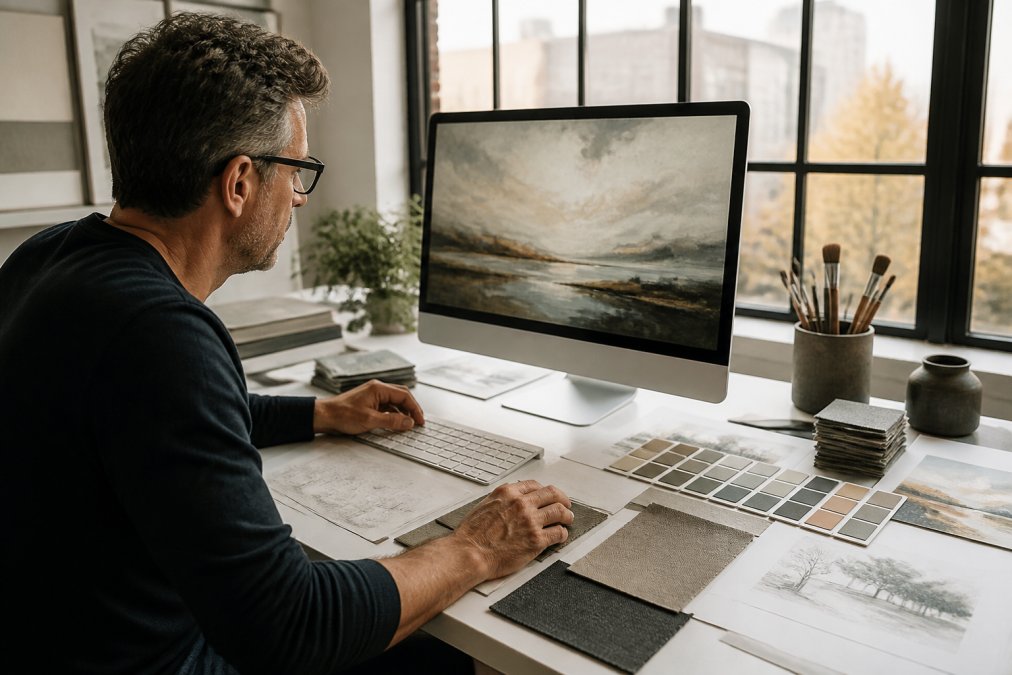
Uploading and Customizing Your Digital Assets
Upload your file in the correct format and resolution. Check the DPI and file size during upload, if your file is 72 DPI, the platform should warn you. Select dimensions, material, and finish (matte, glossy, semi-gloss for paper; stretched or unframed for canvas). Add special requests in the notes field for packaging, shipping, or framing instructions.
Reviewing Mockups and Finalizing Your Order
Review the mockup for layout and proportions. Check that text is readable and key visual elements aren't cut off. Request a color proof if available. Confirm the shipping address, payment method, and delivery date before finalizing.
Commissioning Art Online: Best Practices
Set expectations about revision rounds upfront. Most custom art orders include one or two revision rounds; additional revisions incur fees. Establish payment terms, many artists require 50% upfront and 50% upon completion.
Communicate deadlines clearly. Work backward from your needed date to determine when to order. A 10-day production timeline plus 3-5 days shipping means ordering at least 15 days in advance.
Custom Art Project Timeline and Fulfillment
Lead Times, Batch Ordering, and Rush Options
Standard lead times for custom art printing range from 5-10 business days. Rush production (2-3 business days) usually costs 25-50% more. Batch ordering multiple pieces at once sometimes qualifies for faster production or volume discounts. For commercial projects with tight deadlines, communicate with the printer early.
Shipping Logistics and Delivery Expectations
Shipping costs depend on size, weight, and distance. Most printers offer standard ground (5-7 business days), expedited (2-3 business days), and sometimes white-glove delivery for high-value pieces. Track your shipment and plan for a 1-2 day buffer. Inspect the package upon arrival and document any damage with photos.
Pricing, Profit Margins, and Cost Management
Understanding Platform Fees and Setup Costs
Print-on-demand platforms typically charge 15-30% platform fees plus 2-3% payment processing fees. Splashworks operates differently, in-house production eliminates middleman platform fees, allowing faster turnarounds and more customization.
Wholesale Pricing and Retail Markup Strategies
Most custom art printers offer tiered wholesale pricing: smaller orders (1-5 pieces) have higher per-unit costs; larger batches (10+, 25+, 50+) drop the price significantly. Calculate retail markup based on perceived value. A piece costing $40 wholesale might retail for $120-150 depending on market. Interior designers often apply 25-50% markups; retailers may apply 100%+.
Quality Control and Print-on-Demand vs. Inventory Models
Print-on-demand produces pieces only after you order, reducing upfront investment but increasing lead times (7-14 days) and per-unit costs. POD works well for artists offering unlimited designs or retailers with unpredictable demand.
Inventory-based production requires ordering batches upfront and storing finished pieces. This requires capital investment but significantly lowers per-unit costs and enables immediate customer delivery (2-3 days shipping). Inventory models work for bestselling designs, established retailers, and commercial installations where demand is known in advance.
Splashworks maintains quality control across both approaches, our in-house production and skilled craftsmen ensure every piece meets standards whether it's a single custom order or a 50-piece installation.
Ordering custom art online requires attention to technical details, material selection, and realistic timelines. Whether you're an artist offering custom reproductions, a designer sourcing pieces for clients, or a business installing art across multiple properties, the fundamentals remain the same: quality files, the right material, and a printer who delivers.
Get started with Splashworks and explore how our American-made custom art reproductions can transform your space. From file preparation to final delivery, we handle every step with the precision and craftsmanship your project deserves.
=== FAQ ANSWERS (audit these too, same rules) ===
[1] Q: What file specifications do I need to meet when ordering custom art online? A: Most custom art printing services require high-resolution digital files at 300 DPI minimum for professional quality reproduction. Your file should use CMYK color profile for print accuracy, not RGB. Common formats include PDF, TIFF, or PSD. Check your provider's specific requirements for bleed and trim dimensions, which vary by final product size. Files that don't meet these standards may result in pixelated or color-inaccurate prints.
[2] Q: How long does it typically take to receive a custom art order? A: Custom art project timelines depend on several factors: file preparation (1-3 days), production (3-7 business days), and shipping (3-10 days depending on destination). Batch orders and complex customization may extend production time. Many providers offer rush options for an additional fee if you need faster turnaround. For time-sensitive projects like hospitality installations, confirm lead times upfront and discuss expedited fulfillment options.
[3] Q: What's the difference between giclee prints and standard canvas reproductions? A: Giclee printing uses high-quality inkjet technology to create fine art reproductions with superior color accuracy and detail. These prints typically offer better archival quality and longevity than standard reproductions. Canvas prints provide texture and a gallery-like appearance, while giclee on paper stock delivers precise color fidelity. For art reproduction work, giclee on archival paper or canvas offers the best balance of quality, durability, and aesthetic appeal for residential and commercial settings.
[4] Q: How do I ensure the colors in my final print match my original artwork? A: Use a standardized CMYK color profile when preparing your digital file, as this matches print output better than RGB. Request product mockups before final production to verify color accuracy. Understand that monitor colors differ from printed colors due to display calibration differences. Work with providers who offer color-matching services or samples. Lighting conditions in your space will also affect how colors appear, so consider the final installation environment when approving proofs.
[5] Q: What should I look for when choosing a custom art printing service? A: Evaluate commissioning art online best practices by assessing the provider's file upload capabilities, quality control standards, and customer portfolio examples. Check whether they support your preferred print mediums and custom dimensions. Review their fulfillment options, print-on-demand versus inventory-based models affect pricing and turnaround. Verify they handle e-commerce integration if you're a retailer. Read customer reviews about print quality, color accuracy, and shipping experience. Compare platform fees, setup costs, and wholesale pricing if applicable to your business.
[6] Q: Can I order custom art online if I'm a retailer or interior designer? A: Yes. Many custom art printing services offer wholesale pricing and batch ordering options for design professionals and retailers. You can typically set up an artist portfolio or business account to access bulk discounts, extended payment terms, and dedicated customer support. Some providers specialize in hospitality-scale orders and can handle large installations with quick turnaround. Confirm that the platform integrates with your e-commerce system and supports your inventory management needs before committing.
[7] Q: What are the main cost factors when ordering custom art? A: Pricing depends on several variables: print medium (canvas vs. paper stock), custom dimensions, order quantity, and delivery speed. Platform fees and setup costs vary by provider, some charge monthly subscriptions while others use commission-based models. Wholesale pricing typically applies to bulk orders. Shipping logistics significantly impact final cost, especially for large or framed pieces. To get accurate pricing for your specific project, contact your provider directly with details about quantity, dimensions, and timeline rather than estimating based on generic ranges.
Frequently Asked Questions
What file specifications do I need to meet when ordering custom art online?
Most custom art printing services require high-resolution digital files at 300 DPI minimum for professional quality reproduction. Your file should use CMYK color profile for print accuracy, not RGB. Common formats include PDF, TIFF, or PSD. Check your provider's specific requirements for bleed and trim dimensions, which vary by final product size. Files that don't meet these standards may result in pixelated or color-inaccurate prints.
How long does it typically take to receive a custom art order?
Custom art project timelines depend on several factors: file preparation (1-3 days), production (3-7 business days), and shipping (3-10 days depending on destination). Batch orders and complex customization may extend production time. Many providers offer rush options for an additional fee if you need faster turnaround. For time-sensitive projects like hospitality installations, confirm lead times upfront and discuss expedited fulfillment options.
What's the difference between giclee prints and standard canvas reproductions?
Giclee printing uses high-quality inkjet technology to create fine art reproductions with superior color accuracy and detail. These prints typically offer better archival quality and longevity than standard reproductions. Canvas prints provide texture and a gallery-like appearance, while giclee on paper stock delivers precise color fidelity. For art reproduction work, giclee on archival paper or canvas offers the best balance of quality, durability, and aesthetic appeal for residential and commercial settings.
How do I ensure the colors in my final print match my original artwork?
Use a standardized CMYK color profile when preparing your digital file, as this matches print output better than RGB. Request product mockups before final production to verify color accuracy. Understand that monitor colors differ from printed colors due to display calibration differences. Work with providers who offer color-matching services or samples. Lighting conditions in your space will also affect how colors appear, so consider the final installation environment when approving proofs.
What should I look for when choosing a custom art printing service?
Evaluate commissioning art online best practices by assessing the provider's file upload capabilities, quality control standards, and customer portfolio examples. Check whether they support your preferred print mediums and custom dimensions. Review their fulfillment options—print-on-demand versus inventory-based models affect pricing and turnaround. Verify they handle e-commerce integration if you're a retailer. Read customer reviews about print quality, color accuracy, and shipping experience. Compare platform fees, setup costs, and wholesale pricing if applicable to your business.
Can I order custom art online if I'm a retailer or interior designer?
Yes. Many custom art printing services offer wholesale pricing and batch ordering options for design professionals and retailers. You can typically set up an artist portfolio or business account to access bulk discounts, extended payment terms, and dedicated customer support. Some providers specialize in hospitality-scale orders and can handle large installations with quick turnaround. Confirm that the platform integrates with your e-commerce system and supports your inventory management needs before committing.
What are the main cost factors when ordering custom art?
Pricing depends on several variables: print medium (canvas vs. paper stock), custom dimensions, order quantity, and delivery speed. Platform fees and setup costs vary by provider—some charge monthly subscriptions while others use commission-based models. Wholesale pricing typically applies to bulk orders. Shipping logistics significantly impact final cost, especially for large or framed pieces. To get accurate pricing for your specific project, contact your provider directly with details about quantity, dimensions, and timeline rather than estimating based on generic ranges.
This article was written using GrandRanker


